
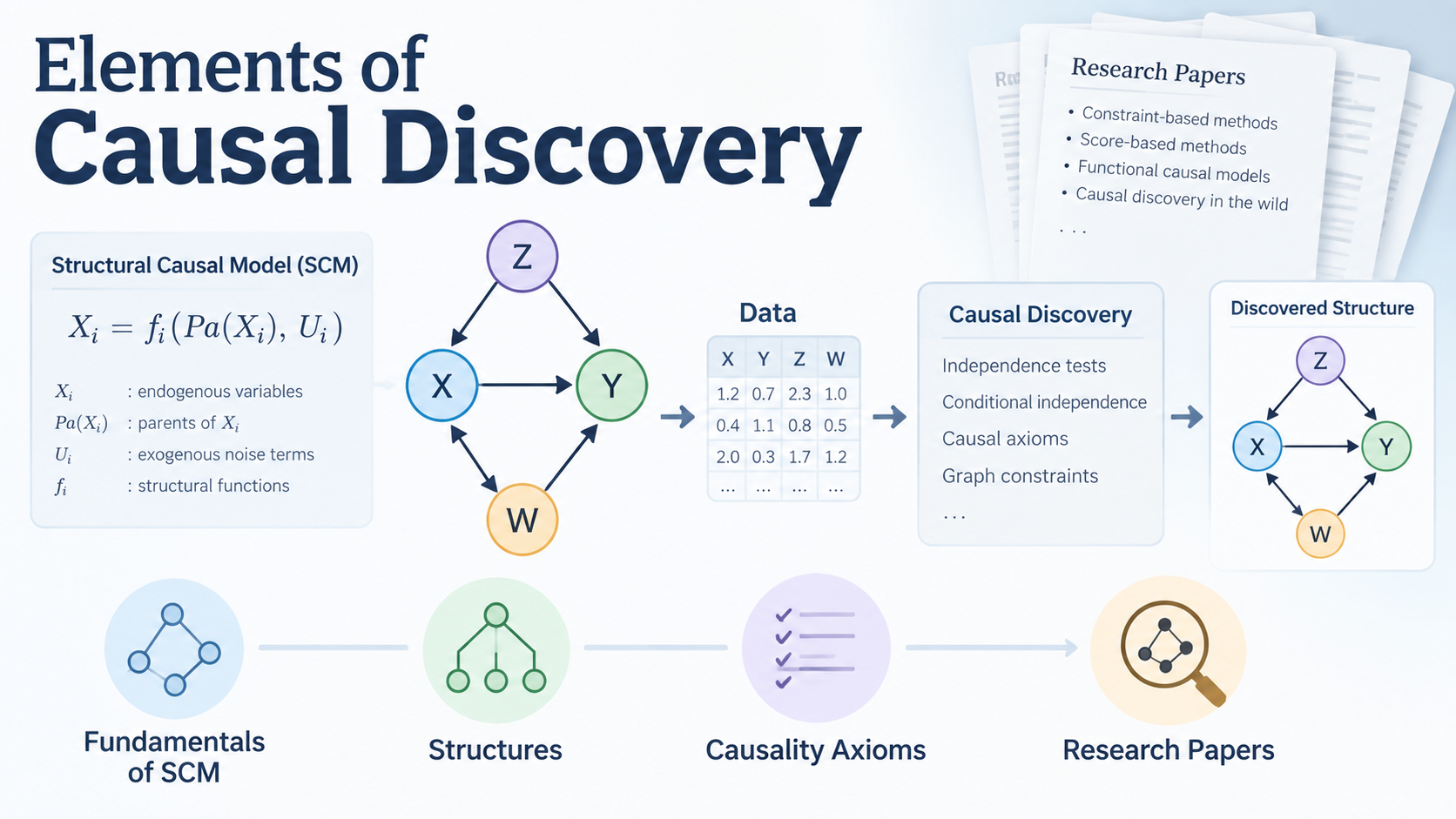
In this seminar, we will address causal structure learning which to infer causal relationships from observational and interventional data. We will begin with structural causal models, graphical concepts, and causality axioms (Markov condition, faithfulness), then cover identifiability and its assumptions. We will study classical algorithms like PC (constraint-based) and GES (score-based), with special attention to bivariate causal discovery for orienting edges within a Markov equivalence class, and methods for fully oriented structures under additional assumptions (e.g., additive noise models, non-Gaussianity). We will then introduce continuous optimization-based approaches for scaling to larger graphs, while being aware of the identifiability guarantees they trade for scalability. Finally, we will cover methods relaxing causal sufficiency to allow latent confounders.
Assessment will consist of assigned 20–25 minute presentation(s), active weekly participation (questions and feedback), and a final written report summary and critical assessment of the assigned topic. Grading will be weighted between (30%) presentation (30%) active participation and (40%) the written report. We will meet weekly with two presentations per session, each followed by a discussion; all of us are required to read the material beforehand.
The course will be offered in English. The presentation as well as the final reports should also be given in English.
Prerequisites include completed introductory probability and statistics, with recommended basic knowledge of graphical models or machine learning; prior causal inference knowledge is helpful but not required.
- Lehrende:r: Michael Kamp
- Lehrende:r: Osman Ali Mian